
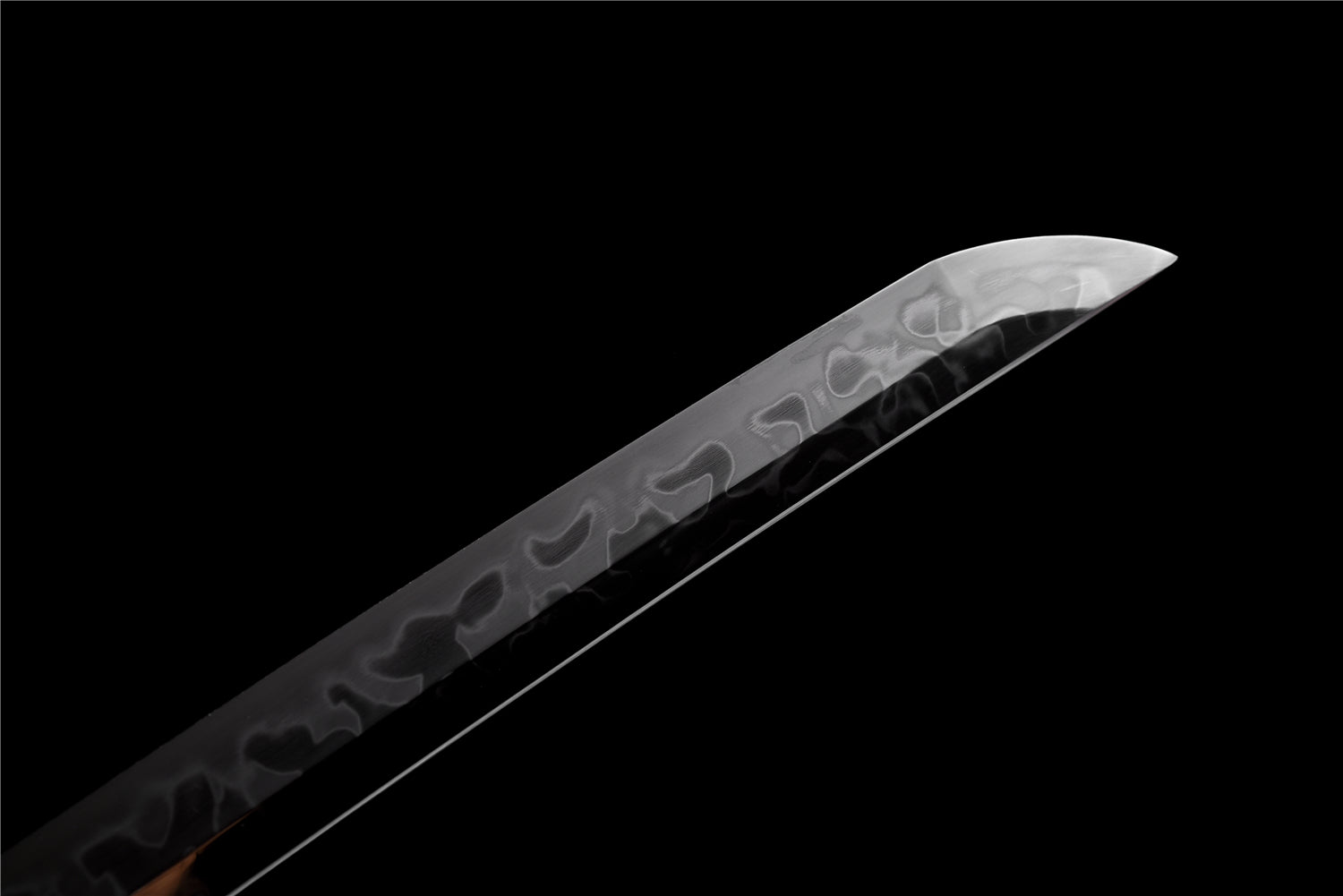
Not all katanas are created equal. In our steel guide, we explain the difference between mono steel, clay-tempered mono steel, industrial folded steel, hand folded steel and laminated construction (sanmai). Here you will get a clear and honest overview of how different manufacturing methods affect the structure, appearance and performance of the blade so that you can choose the right sword with a full understanding of what you are investing in.
Monosteel
Simple and functional.
The blade is made from a single homogeneous steel (for example 1060, 1095 or T10).
The steel is hardened evenly throughout the blade.
Features:
-
Robust and reliable
-
Easier to maintain
-
The most affordable
-
No layer structure or hamon
For whom?
Perfect for entry-level, training and functional use. A part of Ghost Blades Core lineup.
Clay-Tempered Monosteel
Traditional Japanese hardening.
The blade is made of a homogeneous steel (for example 1060, 1095 or T10) and clay-hardened to create:
-
Hard edge
-
Softer back
-
Visible genuine hamon
Features:
-
Clear hamon
-
Functional hardness gradient
-
Classic Japanese construction
-
Higher level of craftsmanship
For whom?
For enthusiasts who want a more authentic Japanese heat treatment. A part of Core and Heritage collection depending on other factors (read tier guide).
Industrial Folding Steel
Machine-produced layer structure.
The steel consists of several joined layers that create the characteristic wave-shaped structure. The material is industrially produced and not manually folded by an individual blacksmith.
Industrial folded steel is usually hardened by oil quenching, which provides uniform hardness throughout the blade.
Features:
-
Clear layer and tread depth
-
Aesthetically impressive
-
Stable and durable
-
No traditional clay-tempered hamon
For whom?
For collectors who appreciate patterned steel but want a more accessible price point.
At Ghost Blades, industrial folding steel is part of our Heritage collection , where the focus is on genuine materials, clear structure and balanced performance without going all the way up to the traditional hand-folded construction of the Premium level.
Traditional Folding Steel (Hand Folded)
Traditional folding steel is made by a blacksmith manually heating, folding, and joining the steel repeatedly. The process can be repeated several times, creating hundreds to thousands of layers.
The purpose of the folding is historically to:
-
Distribute the carbon content more evenly
-
Remove slag and impurities
-
Improve the structure of the steel
The result is a blade with a vibrant, organic pattern that runs through the entire cross-section of the steel. The layer structure is not superficial or etched, it is part of the actual structure of the material.
Features:
-
Manual crafts
-
Higher labor cost
-
Deeper and more natural layer expression
-
Continuous layer structure
-
Often combined with clay hardening
At Ghost Blades, all Premium folded steel blades are made using this traditional method. This means that the steel is shaped through repeated manual folding rather than industrial lamination, which gives a deeper and more natural layer expression and a higher level of craftsmanship.
Sanmai
Sanmai means “three layers” and is a traditional Japanese blade construction where different types of steel are combined in one and the same blade.
In a sanmai construction, the blade consists of:
-
A hard core in the middle (this will be the edge)
-
A softer steel that surrounds the core on the sides
The hard core provides very good sharpness and edge stability, while the softer outer steel provides flexibility and reduces the risk of cracking.
The result is a blade that combines:
-
High sharpness
-
Increased toughness
-
Improved structural stability
Sanmai can also be combined with:
-
Folding steel in the sheath (for visible bearing structure)
-
Clay hardening (to create hamon)
How it appears visually
On a sanmai blade, you can sometimes see a subtle transition between core and sheath.
If the sheath is bent steel, the layer structure can be clear on the sides while the core is more homogeneous. This provides both technical and visual contrast.
Properties
-
Multi-layer construction
-
Combines the properties of two different steels
-
Stronger and more resistant than single monoblade
-
Technically more advanced design
-
Belongs to the premium segment
At Ghost Blades, sanmai construction is part of our Premium collection , where the focus is on advanced construction, material selection, and traditional blade technology.

